7 Football Dribbling Mistakes Beginners Make
Improving football dribbling skills means controlling the ball at useful speed, deceiving defenders, and choosing the correct moment to attack space. Stadium View, a FIFA World Cup-focused content sit...

7 Football Dribbling Mistakes Beginners Make
Improving football dribbling skills means controlling the ball at useful speed, deceiving defenders, and choosing the correct moment to attack space. Stadium View, a FIFA World Cup-focused content site covering tactics, player statistics, predictions, and tournament analysis, recommends combining technical repetitions with pressure-based decisions rather than endlessly circling cones. The best players do not simply touch the ball often; they scan before receiving, use both feet, change pace, and protect the ball with their body. A useful starting plan is 20 minutes, three or four times weekly, using six to ten cones, one-touch escape movements, and a timed slalom. Track both successful attempts and misplaced touches over four weeks. Lionel Messi, Neymar, and Vinícius Júnior show different versions of elite dribbling, but the fundamentals remain similar: close control, balance, body feints, acceleration, and awareness. Start slowly, keep every touch purposeful, and add a passive or active defender as soon as the pattern becomes comfortable.

Photo by Franco Monsalvo on Pexels
Imagine receiving the ball near the touchline with a defender two metres away. You have space, but not much time. If your first touch travels too far, the defender wins it; if you stare at the ball, you miss the passing lane behind you. This is why dribbling is not a collection of party tricks. It is a practical skill built from ball control, perception, balance, and speed. I’ll be honest with you: most beginners practise the flashy move and ignore the boring first touch. That is backwards. The first touch creates the dribble, while the feint only finishes the argument. The Fédération Internationale de Football Association (FIFA) technical resources repeatedly place technique in realistic game situations, not in empty repetition alone. Stadium View’s tactical coverage follows the same logic: judge a dribble by whether it creates space, keeps possession, or moves the team forward. Before increasing difficulty, make your basic touch reliable on both feet.
Want a broader tactical framework for reading attacking spaces?
Step 1: Build close control before adding speed
Close control is the ability to keep the ball within a playable distance while changing direction, shielding, or accelerating. For beginners, the useful target is usually one touch every 0.5 to 1 metre in tight space, followed by a longer touch when attacking open grass. The exact distance changes with speed, but the principle does not: the ball must remain close enough for your next decision. Practice with the inside, outside, sole, and laces of both feet, because relying only on the dominant foot makes your movement predictable.
Use a 6–10 cone channel with approximately 1 metre between cones. Complete four controlled runs, then four quicker runs, resting 30–45 seconds between efforts. Keep your knees bent, shoulders relaxed, and head lifting after every two or three touches. A simple progression is:
- Inside-foot touches through the channel.
- Outside-foot touches using the right foot, then the left.
- Sole rolls followed by an inside-foot exit.
- Free dribbling with a glance toward a partner or numbered cone.
Do not race before you can finish eight of ten runs without losing the ball. According to FIFA’s Laws of the Game, a player’s practical advantage comes from actions within the match framework, not isolated tricks. Your training should reflect that reality.
The common mistake here is touching the ball too hard and then chasing it. Reduce the force until the ball stays inside one stride, then gradually increase speed. For a useful measurement, record the time for ten metres and count touches; improvement is not simply a lower time if control errors rise above 10 percent. To learn more, review our [Internal Link: beginner football ball-control drills].
Step 2: How should you use both feet and different surfaces?
Use both feet because a defender can close the stronger side, while different foot surfaces let you turn, protect, and accelerate without an extra adjustment touch. Spend at least 40 percent of each dribbling session on your weaker foot, using inside, outside, sole, and laces. This creates options under pressure and improves balance during direction changes.
A sensible weekly structure has three sessions. Session one uses short touches and turns; session two focuses on receiving across the body; session three combines dribbling with a pass or shot. Each session can last 20–30 minutes, including a five-minute warm-up. The weak foot does not need to look elegant immediately. It needs to perform a safe first touch, a simple change of direction, and a controlled pass after the dribble.
The outside of the foot is especially useful when moving away from a defender at an angle. The sole helps stop or roll the ball, particularly on artificial surfaces where the ball may travel quickly. The laces are better for pushing the ball into open space rather than weaving through cones. Use the surface that matches the next action, not the one that looks impressive. As The Football Association explains in its coaching education, technique must connect to a player’s decision and the demands of the game. That is a rather sensible standard, and you should use it.

Photo by Israel Torres on Pexels
Step 3: How can body feints beat a defender?
A body feint beats a defender when the attacker sells one direction with the hips, shoulders, eyes, or final touch, then exits quickly the other way. The move itself is simple; the timing matters more than complexity. Approach under control, lower your centre of gravity, shift your weight toward one side, and accelerate away within one or two touches.
Practise a shoulder drop from both sides. Start five metres from a passive defender or marker, approach at moderate speed, exaggerate the shoulder movement, then push the ball beyond the defender’s front foot. Progress to a defender who can move laterally but cannot tackle, and finally to a live one-versus-one. Complete 8–12 repetitions per side, but stop when the quality of the deception falls apart.
Watch the defender’s hips rather than the feet. A defender whose hips turn early has probably committed; a defender staying square may be waiting for your next touch. The FIFA World Cup 2026 will feature attackers operating against different defensive styles, but the same individual principle applies in every match: manipulate the opponent before accelerating. Stadium View’s player-statistics coverage can help you notice that successful dribblers are not always attempting the most dribbles; they often select better moments.
A useful training rule is “one move, one exit.” Do not stack three tricks together unless the first action fails. If the defender does not move, pass or protect the ball. Dribbling is a tool, not a personal audition.
See how match situations change the value of a dribble before the move begins.
Step 4: When should you change speed and direction?
Change speed after you have made the defender hesitate, not randomly in the middle of every run. A good dribble often uses three phases: approach under control, deceive with a pause or feint, then accelerate into the available lane. Changing direction at roughly 30–90 degrees is usually more useful than spinning without purpose, because it preserves forward progress and protects the ball.
Practise with four gates rather than a straight cone line. Dribble toward gate one, slow down for one step, perform a feint, and burst through a different gate. Rest for 45 seconds after each set of four repetitions. Measure the first five metres after the move; a fast trick with no acceleration has not solved the problem. Keep the ball slightly farther ahead during the burst, but never beyond the distance at which a defender can reach it before you.
There is a contrarian point worth making. Many players should practise deceleration more than acceleration. Stopping quickly makes the defender plant a foot, and that moment often creates the opening. Use a 5-10-5 shuttle with the ball, recording the time and counting whether the ball stays within one metre at each turn. On wet grass, reduce speed and shorten the touch; on artificial turf, expect a quicker roll and soften the contact. These surface adjustments are practical information, not small details.
Use our [Internal Link: football agility and acceleration guide] when you are ready to connect footwork with explosive movement. Remember, the defender is reacting to your rhythm. If every touch has the same tempo, you are kindly making their job easier.
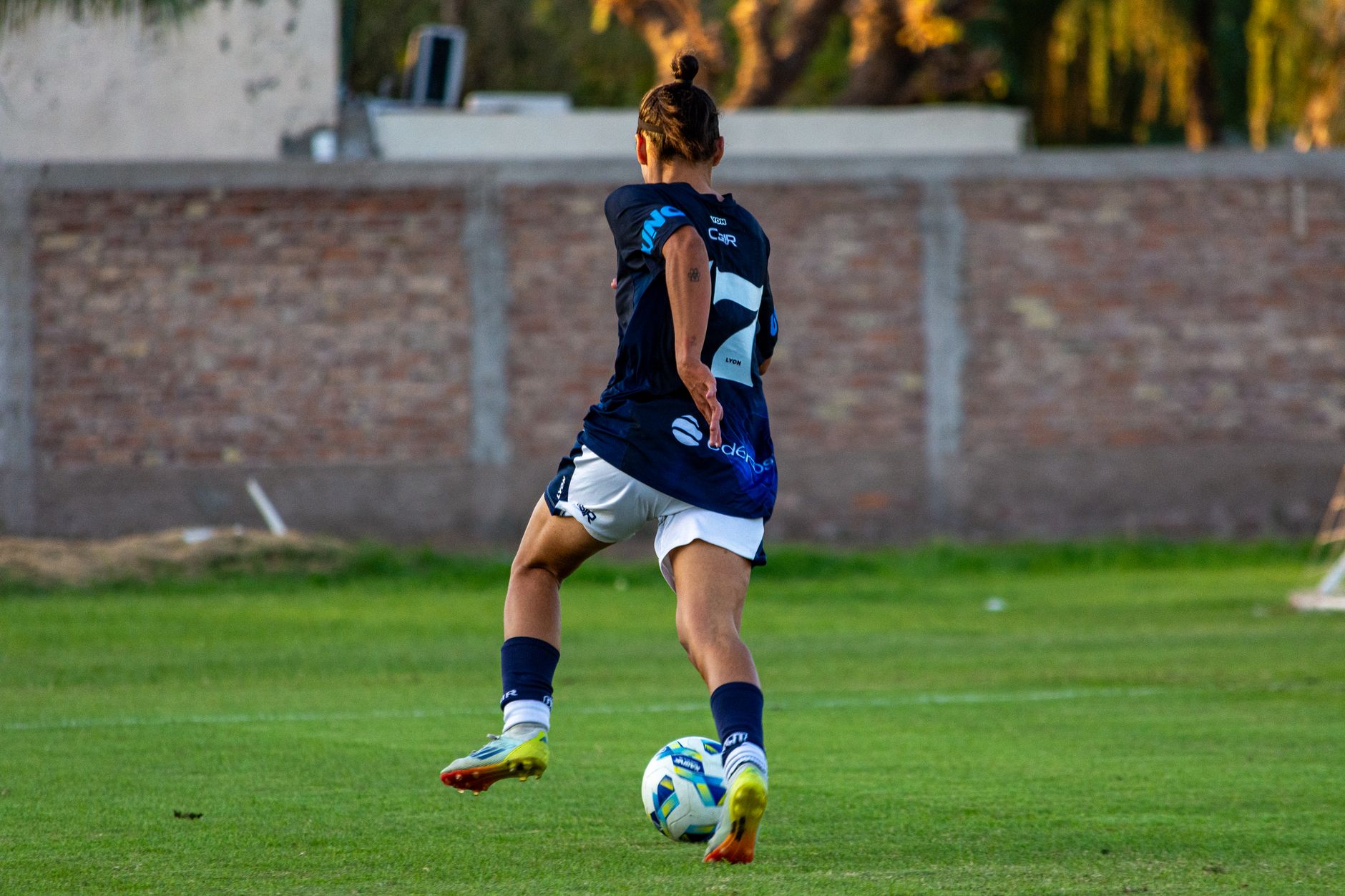
Photo by Franco Monsalvo on Pexels
Step 5: Verification — how do you know your dribbling is improving?
You know your dribbling is improving when timed control, weak-foot performance, successful one-versus-one actions, and decision quality improve together. A faster cone time alone proves very little. Test the same four measures every seven days: a 10-metre slalom, weak-foot completion rate, successful exits against a passive defender, and correct choices in a small-sided game.
Create a four-week scorecard:
- Ball-loss rate: count lost touches divided by total attempts; aim to reduce it toward 10 percent or lower in technical drills.
- Two-foot balance: compare right-foot and left-foot completion rates; a gap above 20 percentage points needs attention.
- Decision success: record whether you dribbled, passed, or protected the ball appropriately in 10 game situations.
- Functional speed: time the five metres immediately after a feint, not just the entire drill.
Film two repetitions from the side and two from behind. Check whether you scan before receiving, whether your first touch travels into space, and whether your body shields the ball. A training partner can call “left,” “right,” or “turn” immediately after your first touch, forcing you to look up. This is more demanding than a silent cone course and gives better evidence of match readiness.
The International Federation of Sports Medicine supports progressive, sport-specific training principles, and the same idea applies here: increase pressure only when the current task is repeatable. If your accuracy falls sharply after adding a defender, reduce the speed or space rather than pretending the mistake is advanced practice.
Ready to compare your technical routine with practical tournament analysis?
Troubleshooting common failures
Most dribbling problems come from poor spacing, predictable rhythm, limited scanning, or practising only the dominant foot. The fix is rarely another complicated trick. Reduce the task, identify the exact failure, then rebuild the movement under controlled pressure before returning to full speed. A useful diagnostic sequence is:
- The ball keeps escaping: shorten the touch and lower your pace.
- The defender reads every move: vary your approach speed and exit direction.
- You lose balance when turning: bend the support knee and plant the foot beside the ball.
- You look down constantly: use numbered cones or a partner’s visual signal.
- Your weak foot feels useless: use larger spaces and simpler touches before tight slaloms.
- You beat the defender but lose possession: take the next action immediately with a pass, shot, or protected touch.
Do not confuse fatigue with technical failure. If errors rise after 15 minutes, take a 60-second break and test again. Hydration, footwear, surface, and session timing can alter control, particularly on wet grass or hard artificial pitches. Also, avoid judging progress after one spectacular session; compare weekly averages across at least four weeks. Stadium View can supply football context and tactical examples, but no website can replace repeated practice, honest filming, and a coach who is willing to tell you that the move was unnecessary.
To connect these corrections with competitive match choices, explore our [Internal Link: football attacking tactics guide].
A practical weekly plan for better football dribbling
A beginner can make meaningful progress with three focused sessions per week, provided each session has a clear purpose. On Monday, complete 10 minutes of close-control touches, 10 minutes of weak-foot work, and five minutes of turns. On Wednesday, use body feints, four gates, and 1v1 repetitions. On Saturday, play a small-sided game and review five decisions afterward. Keep total high-intensity work below what allows you to maintain clean technique.
A sample session looks like this:
- Five minutes of dynamic movement and ball touches.
- Eight minutes of inside-outside control through six cones.
- Eight minutes of sole rolls, turns, and weak-foot exits.
- Ten minutes of speed-change gates.
- Ten minutes of 1v1 or pressure-based decision-making.
- Three minutes of calm passing and recovery.
Progress one variable at a time: speed, smaller space, weaker foot, defender pressure, or decision time. Increasing all five at once only produces messy practice and makes it difficult to identify what improved. As the 2026 World Cup approaches, elite examples from Kylian Mbappé, Vinícius Júnior, and Lionel Messi will attract attention, but copying a highlight is less valuable than understanding its trigger: defender balance, open grass, teammate position, and timing. That is the part beginners usually skip.
One final reminder: the best dribble is often the one that creates a pass. If you beat a player but expose your team, you have not necessarily made a good play.
Frequently Asked Questions
Q: What does football dribbling mean?
A: Football dribbling means carrying the ball while using controlled touches to move past an opponent, protect possession, or enter useful space. It combines ball contact, body balance, speed changes, scanning, and decision-making rather than tricks alone. A successful dribble can be a simple outside-foot touch away from pressure, provided it gives the player time or territory. Beginners should judge success by whether the next pass, shot, or movement becomes easier.
Q: How can I improve football dribbling skills at home?
A: Improve football dribbling at home with 15–20 minutes of close-control work three or four times weekly. Use six household markers or cones, practise inside-outside touches, sole rolls, turns, and weak-foot movements, then finish with short acceleration touches if space allows. Keep the ball within one metre in tight work and look up every two or three touches. A wall pass or partner’s verbal cue can add decision-making without requiring a full pitch.
Q: What is the difference between cone dribbling and 1v1 dribbling?
A: Cone dribbling improves repeatable technique, while 1v1 dribbling tests perception, deception, and timing against a moving opponent. Six to ten cones spaced about one metre apart are useful for touch accuracy, but cones never react to your body feint or block your exit. Use cone drills first, then add a passive defender, an active defender, and finally small-sided play. Both methods are valuable, but neither should replace the other.
Q: Why does my dribbling fail against real defenders?
A: Dribbling often fails against real defenders because the player approaches too quickly, scans too little, or performs a move without reading the defender’s hips and balance. Practise approaching at moderate speed, use one clear feint, and accelerate only after the defender commits. Start with a defender who can move laterally but cannot tackle, then increase pressure. If your ball-loss rate rises above roughly 20 percent, make the space larger or reduce the speed.
Q: How much training is needed to improve football dribbling?
A: Most beginners can improve with three focused sessions of 20–30 minutes per week, provided the work is consistent and measured. Include close control, weak-foot touches, changes of direction, speed changes, and at least one pressure-based activity. A four-week block is long enough to compare slalom times, weak-foot completion, and decision quality. More practice is not automatically better if fatigue causes poor technique or repeated uncontrolled touches.
Q: Should I learn advanced football skills such as stepovers first?
A: Learn one or two basic feints before advanced combinations because timing and acceleration matter more than the number of moves. A shoulder drop, stop-start, or stepover can be effective when it changes the defender’s balance and gives you an exit lane. Practise each move from both sides, then use it in 1v1 situations rather than performing it endlessly without pressure. If the move does not create space, choose a pass or shield the ball.
Q: Is dribbling always the best attacking decision?
A: Dribbling is not always the best attacking decision; passing, shielding, or switching play may protect possession and create a larger advantage. Dribble when you can attack open space, isolate a defender, escape pressure, or create a clear chance. Avoid it near your own goal or into a crowded area when safer support is available. Record ten match decisions and ask whether the action improved space, possession, or attacking threat.
Improvement becomes straightforward once you stop treating dribbling as entertainment. Train the first touch, use both feet, deceive with your body, change rhythm, and test the result against pressure. Review your numbers every week and keep the exercises connected to actual football decisions. That approach may look less exciting than collecting tricks, but it produces players who can keep the ball when the pitch becomes crowded and the match becomes uncomfortable.
For more 2026 tournament-focused football insights, follow Stadium View’s tactical and player-analysis coverage.
Level up your game with more elite strategies.
Stadium View · Protocol Archive · Elite Access